Envy-inducing car camping videos have people like me convinced we need a trust fund to sleep in our trunks. Like you, I’ve made my best memories stretching my dollars, but when looking for help, online budget camping resources mostly just tell me what “Cheap 25 Items Under $25” I need to buy to somehow save money…
Full disclosure: There are 3-4 affiliate links in this article, but I want to flip the script and share mostly what I don’t do when car camping, and share the few items that do save me money each time I use them. All without feeling like I’m on a budget, and making the trip easier and simpler.
So How Do You Car Camp on a Budget?
- Bring prepared foods. Avoiding restaurant food saves money during every meal.
- Don’t bring a cooler. This prevents repeated purchases of ice, and losing any food due to spoilage.
- Use a budget camp stove. When wood gathering is prohibited, using a camp stove instead of buying firewood saves money for each cook.

The biggest effects you can have on the amount of money you can save is determined by decisions you make before you leave home. This means the easiest and most effective way to car camp on a budget is to be an intentional packer. There are specific things you will need no matter your budget, food, fuel, and sleep. To car camp on a budget, rather than buying cheap items in those 3 categories, shift your mindset to reducing costs in each category.
For instance, if you opted to bring something needing a cooler (a half gallon of milk), you’ve made the decision that you will be buying ice to keep it cool until all the milk is gone. There is nothing wrong with milk or ice while camping, but by making the decision to pack something needing ice and a cooler, we are committing to purchasing ice until all the refrigeration-needed foods are gone. If not, the food will spoil, meaning even more money lost on food that was purchased but can’t be eaten.
Food is the easiest to control money pit when camping or traveling. Here I’ll share the ways I reduce costs before I leave the house.
How to Save Money on Food While Car Camping
How much food, and the type of food, you pack will be the deciding factor on how much money you’re able to save once out on the road.
The allure of dining out is tempting when you need to get out of the car for a bit, and the idea that “fast food is cheaper” can be a difficult thought to beat while driving down the highway during lunch time, but there are hefty price tags tied to both these days.
According to the Bureau of Labor Statistics, fast food prices’ average hike from October 2022-2023 was over 6%.
The more expensive Chipotle raised prices 3% in one month, October 2023, which was its 5th price hike in 2 and a half years.
Additionally, the (once) cheaper McDonald’s raised prices 10% in 2022 and an extra 10% in 2023.
https://www.businessinsider.com/fast-food-isnt-cheap-anymore-2023-11
With fast food becoming more and more expensive, at an even quicker rate than before, preparing meals in advanced can reduce $10-$20+ dollars per person per day, depending on how many people are in your party, and how many meals are eaten.

But, there is an extreme convenience to fast food while traveling to a destination, so what are some foods that can replace that convenience? Remember, the these foods aren’t going to be exciting, but you’re saving $5 – $10+ each time you’re eating!
- Peanut Butter Sandwiches
- Make several before you leave
- Wrap in saran wrap or foil to keep separate
- Most nut butters in general keep well out of refrigeration
- Peanut Butter and Banana Sandwiches
- Elvis’s favorite sandwich
- They’re fine..
- Tuna Salad Sandwich
- Bring some cans of tuna and a loaf of bread. Maybe some mustard or mayo packets from a truck stop too
- Have your passenger make them as needed when on the road or pulled over at a rest area
- Cup Noodles/Ramen Noodles in a Cup/Bowl
- Stop at a truck stop to use their microwave and boil some water and pour it into the cup
- I’ve put them into a thermos and eaten them on the road this way
- If there are no truck stops, you can use a Rest Area to boil some water with your camp stove
If you REALLY don’t have time to microwave some water outside of the car, you can buy an electric kettle for your car. They’re pretty cheap and will be used A LOT.
There are two affordable ones on Amazon, one for cheap, one for cheaper.


With the ability to boil water, your opportunities to bring food that doesn’t require a cooler becomes a lot more broad.
You can now cook…
- Spaghetti – Bring a Can of Spaghetti Sauce
- Boxed Mac and Cheese
- Mashed Potatoes
- Oatmeal
- Virtually all Freeze Dried/Dehydrated Camping Meals
- Bear Creek Dry Soup Mix, and so much more
To cook any of the above, this is the method you can use pretty simple. For noodles as an example:
- Boil the water
- Pour the water into your thermos
- Place the noodles into your thermos and close the lid
Wait about 2-3 times longer it’d normally take to cook. So, for spaghetti that usually takes 10min to cook in an actively rolling boil, keep the spaghetti in the thermos with the boiled water for 20-30min instead.
- Then, drain the water and you have your cooked noodles!
This video demonstrates the method in under 2 minutes.
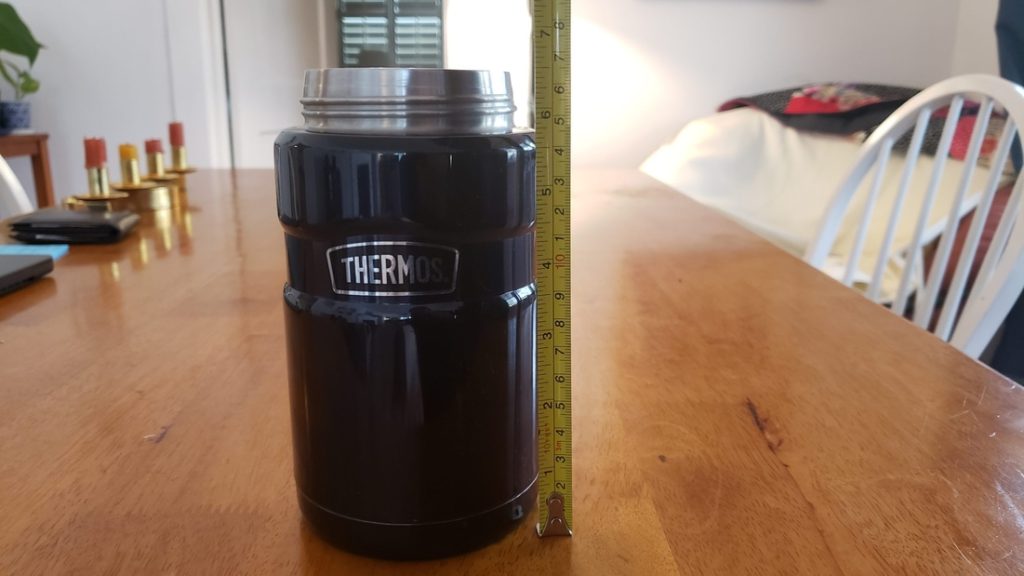
The thermos I use for this method is a Thermos Food Jar, I use it to keep my leftovers from the meals too. I’ve eaten still hot mashed potatoes out of this food jar close to 10 hours after cooked.

Car Camping on a Budget: Bid Farewell to Coolers and Ice Costs
The trusty cooler… a staple of camping trips worldwide.
While it may seem like a necessity for keeping perishable foods fresh, the ongoing expense of purchasing ice can quickly add up over the course of your trip.
Not only will ditching the ice and cooler save you money on ice every day, it will save you money on food loss when water inevitably gets into your food packaging. Or when an item spoils because a cooler was opened too much when the ice was hours old.
In those cases, the loss is compounded; you’ve purchased the food, now you have to replace the food without being able to utilize the first purchase! But here’s the good news: you can save a bundle by ditching the cooler altogether and opting for non-perishable meals instead.
Adding canned goods to the list of boil-ready snacks and meals above greatly widens your options.
Shelf-stable foods that don’t require refrigeration like, cans, boxes, and spices, can be packed and prepared without the need for ice. Not only will this save you money daily, but it greatly simplifies your packing and preparing process as well. It will make preparing food at your campsite more straightforward and will be one less thing to worry about on your travels, making meal times at the campsite more about relaxing taking in the scenery, than preparing food and shuffling through ice.
Camp Cooking on a Budget: Ditch the Firewood – Embrace the Camp Stove
To be fair, life doesn’t get much better than cooking over an open flame on a summer night. While it is enticing, it’s important to consider the cost of firewood every night, or for every meal. In more and more parks lately, firewood must be both local and heat treated, meaning a bundle of 5-7 logs are typically $7+. Near highly regarded parks out West (Zion, Yellowstone, Yosemite), I’ve seen prices reach $10 for a bundle, and just this winter 2023, I’ve seen $12 for a bundle of 8 logs at a major grocery chain.
When penny-pinching nowadays, if I can’t burn wood gathered by myself at the campground, I’m cooking on a stove and saving any wood I had to purchase for leisure nights instead of cooking purposes.
You can buy a $50-$100 Coleman Stove if you’d like (I do have one and it will likely outlive me), but I get away with a much small and cheaper option 90% of the time. I like it more as well as it’s quicker and easier to use:
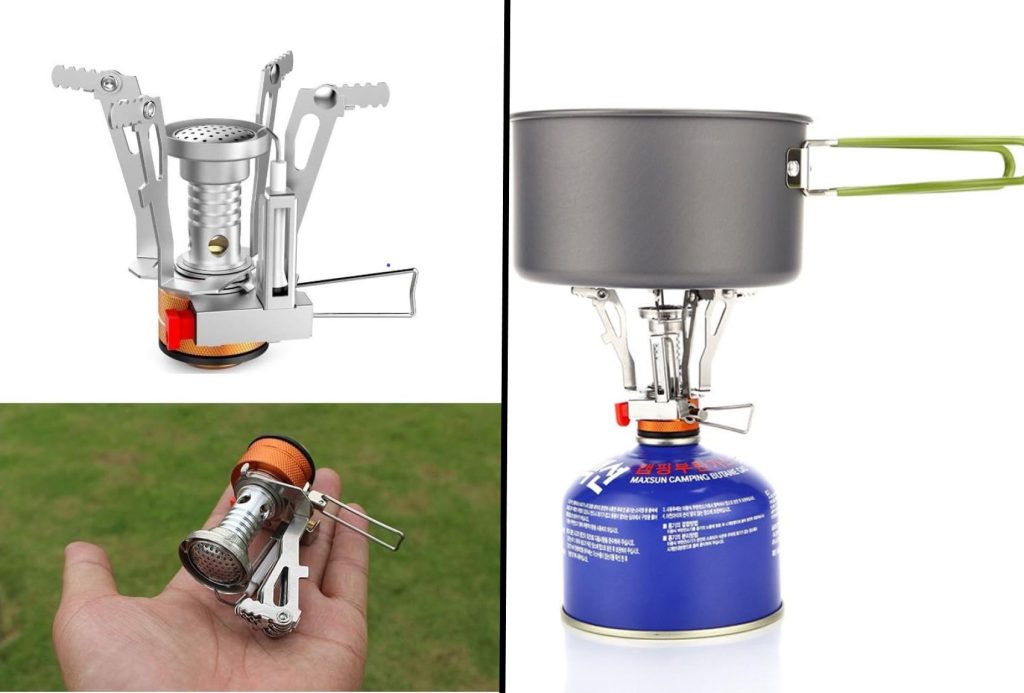
These backpacker stoves screw directly into a fuel canister as you can see on the right side of the image above. You can buy them at Walmart, Target, online stores like Amazon and others, etc. Just like your prepacked meals, each time you use these over store bough firewood, you’re saving $5 – $10!
There are many more varieties of these small backpacker stoves, including ones that are $100+ name brand ones, but I’ve found the Walmart one I was gifted from a friend 10 years ago still works great.
Camping on a Budget: Adding Up Our Savings
So now let’s run through a scenario to see how much we’ll save.
Let’s assume we’re on a 7 day trip. You, and your significant other.
You spend 1 day en route to the destination, and 1 day returning. Let’s assume both days you make your own, or skip, breakfast, and only eat out for lunch and dinner.
You both can be thrifty when needed, so you only spend $7 each after tax, per meal. $7 x 2 meals each = $28 to get to the destination, and $28 to get home.
$56
You buy one snack each, at a gas station, one the way there and on the way back. A total of 4 snack purchases for the whole trip. A snack is $3.50 each, after tax. $3.50 x 4 snacks = $14
$14
We’re at the campsite now, we get 5 days there. The park you’re at only allows the burning of heat treated firewood.
You bought your firewood for the first two nights an hour out where it’s cheaper, $7 per bundle.
The first two nights, you let yourselves splurge, you burn a whole 10 logs (two bundles) per night cooking and relaxing. You have 100% earned your time to relax.
$28
The next three nights, you save and only burn one bundle a night. It’s not as fun, but firewood is $10 here after tax… $10 x 3 nights = $30
$30
All this time you’ve had your cooler and your ice. You leave the house with ice from home, so the first day en route to the destination, you’re all set!
But this is summer, some of the time traveling the cooler got in the sun while in the car. We opened the cooler once every few hours to get something out. One time we got out of the car for 15-20 minutes, we parked in the shade and cracked the windows, but the car was still toasty when we got back in, the cooler still warmed up. The ice is getting pretty watery by the end of the travel day.
The next morning, we buy ice right away. We’re at our destination now, things are pricier. $5 per bag.
We have 5 days left, let’s say we only bought 4 additional bags of ice, for 5 total purchases. $5 x 5 bags of ice = $25.
$25
As you can see, these are VERY conservative estimates. We likely bought more than 2 snacks each, probably bought a bag of ice the first night so we don’t start the trip out with spoiled food, maybe didn’t skip breakfast on both travel days, and likely ate out at least one other time. Maybe it wasn’t a $7 fast food meal either.
Even with these conservative estimates, we saved $153, or $21.85/day! That is a lot of gas in the tank…
According to energy.gov, the average mid-size 2017 North American car made 27 highway miles per gallon.
As of writing this, the U.S. average price of gasoline is $3.27/gallon.
So our $153 saved by making sandwiches and forgetting our coolers will buy us $46.78 gallons of gasoline.
($153 saved / $3.27/gal)


Leave a Reply